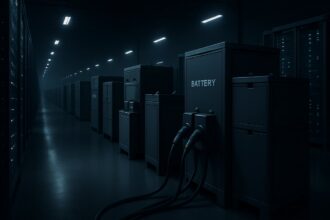
The scale of investment flowing into artificial intelligence infrastructure today is unlike anything in technological history. According to Gartner, worldwide spending on AI is forecast to total $2.5 trillion in 2026, a 44 percent increase over 2025. This massive capital deployment raises a fundamental question: can the construction boom needed to support this demand actually be sustained, or are we heading toward a painful correction?
The answer lies in examining three critical dimensions: power infrastructure constraints, construction timelines and capacity, and the historical precedents that illuminate both the opportunities and pitfalls of mega-infrastructure build-outs.
The most immediate bottleneck isn’t silicon—it’s electrons. AI data centers consume enormous quantities of electricity, and the facilities being planned today make previous generations look modest. AI training and inference are driving data center development from 25 megawatt campuses to gigawatt-scale hubs.
Nuclear power offers compelling advantages for hyperscale AI facilities: it provides 24/7 carbon-free power with unmatched capacity factors. The most visible example is Microsoft’s landmark deal with Constellation Energy to restart the dormant Unit 1 reactor at Three Mile Island, which will provide 835 megawatts of carbon-free electricity.
For nuclear, costs are expected to fall as programs ramp—but this assumes the industry can execute on early projects. The critical question is whether the construction ecosystem can deliver at this scale.
Historical parallels are instructive. Between 2013 and 2024, total global corporate investment in AI reached $1.6 trillion. This dwarfs the Manhattan Project ($36B), the International Space Station ($150B), the Apollo Program ($250B), and the US Interstate Highway System ($620B).
Several risks could derail the AI infrastructure boom: overbuilding and demand miscalculation, regulatory delays, execution risk on nuclear projects, and physical and cybersecurity risks.
The AI data center construction boom is likely to be sustained over the coming decade, driven by fundamental demand. However, the path forward will be far from smooth. The historical analogy that fits best may not be the Interstate Highway System or Apollo Program—instead, the AI infrastructure boom resembles the railroad expansion of the 19th century: driven by private capital, enabled by technological innovation, and subject to periodic boom-and-bust cycles.
Contact us: https://auwome.com/contact/
Written by: SeniorWriter
Sources
- VCI Global’s V Gallant Launches Malaysia’s First NVIDIA-Powered AI GPU Computing Center; Debuts Intelli-X Enterprise LLM Platform – Yahoo Finance — Google News
- AMD targets AI infrastructure boom with MI450 ramp and hyperscaler deals – digitimes — Google News
- Vast Forward 2026: Vast Data Introduces Polaris to Orchestrate Globally Distributed AI Data Infrastructure Across Hybrid Multicloud Environments – StorageNewsletter — Google News