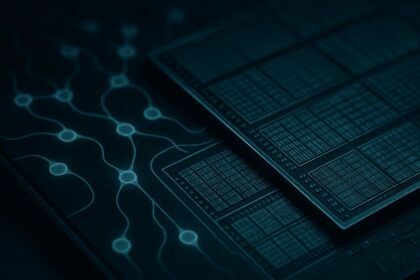
Recent research from KAUST and Compumacy demonstrates that multi-workload co-optimization significantly enhances the energy efficiency and versatility of in-memory computing (IMC) AI accelerators. By ...
In early 2026, the AI accelerator industry is shifting toward heterogeneous silicon platforms, in-memory computing, and enhanced data movement via 25G Ethernet. Broadcom’s $100 billion investment in s...
OpenAI and Oracle's Project Stargate is pioneering AI data centers with power demands reaching 4.5 gigawatts, equivalent to four nuclear reactors. This scale challenges existing energy grids and infra...

US data centers' electricity demand, driven by rapid AI infrastructure growth, is nearing levels comparable to several major cities combined, posing significant challenges for grid stability. This ana...
As agentic AI systems gain greater autonomy, their execution environments face heightened security risks that traditional methods cannot fully address. This analysis examines how integrating practical...

Data center operators are shifting toward off-grid power solutions and pausing large AI infrastructure expansions due to energy grid challenges and financing constraints. This analysis explores how th...

AI infrastructure is undergoing a transformation driven by the integration of processing units with connectivity components and the expansion of edge and micro data centers. This shift addresses laten...

NVIDIA's NVFP4 low-precision format significantly enhances AI model training and inference by boosting throughput and energy efficiency without sacrificing accuracy. This analysis explores NVFP4's tec...
In 2026, AI infrastructure is reshaped by NVIDIA's NVFP4 low-precision format, the rise of edge and micro data centers, and enhanced security models for agentic AI. This analysis explores how these co...

In 2026, AI chip design is evolving through integrated innovations in on-chip security, low-precision training formats like NVIDIA's NVFP4, and dynamic runtime cost optimization via coding agents. The...